

What IF...We Trained For Democracy Like it was a Sport?
Healthy Democracy Needs Strong Civic Muscles


Dear Friends,
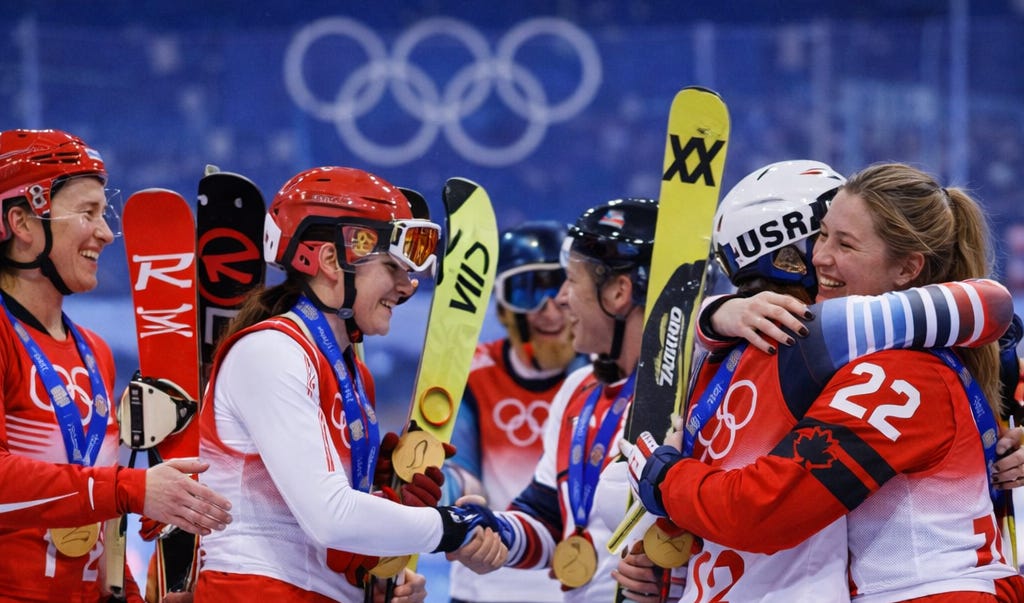
As we approach this year’s Super Bowl and the Winter Olympics, sports are on the collective mind. Many of us are parents of young athletes, and we know how hard they work. Athletes don’t just show up and hope for the best. They train—intentionally and rigorously. They push themselves and their teammates. They learn the nuances and complexities of the game they’re playing.
What IF…we trained for democracy the way athletes train for competition? What civic skills, mindsets, and discipline would we need to be successful? What would “winning” even look like in a healthy democratic society?
At the Interactivity Foundation, we abbreviate our name as IF to signal democratic possibility. "What IF…” is our foundational question that opens imagination, invites experimentation, and keeps the democratic game in play. Each Wednesday we offer a new topic and bold question designed to open collective possibility.
Keep reading to learn more about discussion resources and upcoming events that can help you build new civic muscles. If you haven’t done so already, please subscribe to our newsletter or share it with a friend.
What are civic muscles and how do we get them?
There are many types of civic muscle: institutional reform muscle, electoral muscle, organizing muscle, protest muscle, boycott muscle, and (non)violent action muscle. As with the human body, no single muscle sustains democracy on its own; civic muscles are connected by shared tissue and function best when developed and used together.
At the Interactivity Foundation, we focus our efforts on collaborative discussion muscle. We help people build the skills to deliberate across difference and cultivate the mindsets needed to see others as co-authors of a shared civic world. If democracy is the “game,” it is not a static system but a practice—one that must be learned, rehearsed, and played together. As in any sport, there will be wins and losses, but the work is to stay in the game.
Collaborative Discussion Muscles
1. Civic competence and judgment
Democratic citizenship requires the ability to inquire, reason, and exercise judgment in public life—not merely to register preferences. Democracy depends on citizens learning how to think together about shared problems through experience and reflection. As John Dewey reminds us, “Democracy is more than a form of government; it is primarily a mode of associated living.”
2. Relational and pluralistic engagement
Democracy is fundamentally relational, grounded in engagement among diverse and equal persons whose differences are not obstacles but conditions of political life. Democratic practice requires recognizing others as legitimate co-participants in a shared world. As Hannah Arendt observed, “Plurality is the condition of human action.”
3. Constructive engagement with conflict
Conflict is not only inevitable—it is generative. Growth does not occur without tension. But for democracy to endure, conflict must be structured so that opponents remain adversaries rather than dehumanized enemies. Democratic life depends on the ability to sustain disagreement without collapsing relationships. Chantal Mouffe describes this democratic task as transforming “antagonism into agonism.”
4. Awareness of power and inequality
Democratic participation cannot be separated from structural inequalities of power, voice, and recognition. Healthy democracy therefore requires the civic muscle to identify, name, and contest exclusion and domination within political processes. As Iris Marion Young stated plainly, “Democracy requires not the absence of power but the contestation of power.”
5. Civic imagination and democratic hope
Democracy also depends on the capacity to imagine alternative futures and to sustain hope that collective action can reshape political life. Without moral imagination and democratic faith, participation withers. As Cornel West reminds us, “Democracy is not a finished product but a way of being in the world.”
If you are ready to build your civic muscle consider the following
Register for one of our webinars to learn more about our free facilitation plans, discussion guides, innovative tool, and collaborative discussion toolkit! You can use these resources to start practicing and leading democratic discussions.
If you are interesting in thinking more deeply about the role of sports and society, check out our three-part, sustained Sports Facilitation Plan. Download it, tweak it, modify it for your own discussion needs. Or, check out our full resource library with over 60 free tools.
Register to become a Certified Collaborative Discussion Coach. This 15-hour training introduces collaborative discussion concepts and offers a deep dive into how to facilitate activities from the collaborative discussion toolkit. This is a highly interactive training. Space is limited to ten people.
As always, don’t hesitate to reach out and connect with us. We would love to learn more about what you are doing and we are always interested in connecting, collaborating, and being on this pro-democracy team with you.
Keep the faith,
Shannon Hartman & Hayden Mauk