

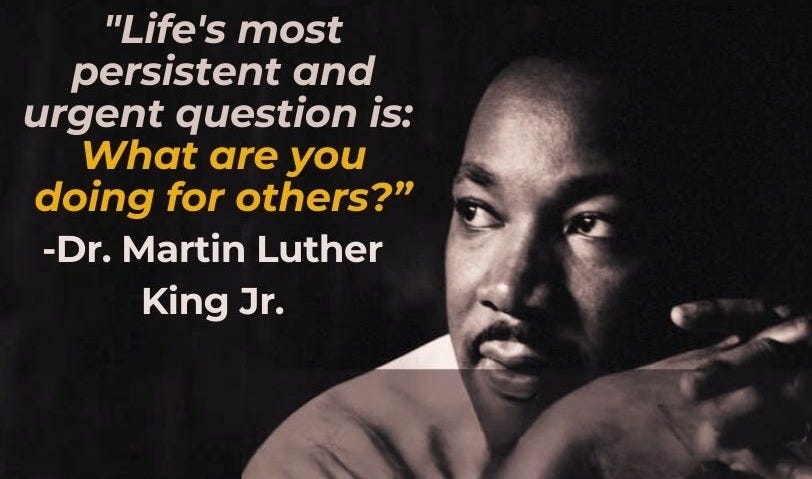
Dr. King's Urgent Question...
Honor Martin Luther King Jr.'s Legacy By Engaging in Civic Discussion

Dear Friends,
Dr. Martin Luther King Jr. called upon us to engage in civic discussion with one another.
Discussion gives us the opportunity to choose love over hate, find compassion for those who are suffering, and work to eradicate fear, greed, and prejudice.
Dr. King dared to ask “What If….”
What if we could just start by talking with each other to discover our shared humanity? What if we could build a world that treated everyone with dignity and respect? What if we empowered everyone to live our best lives with freedom, security, and a deep commitment to others’ well being?
One of the best ways to honor Dr. King’s legacy on this upcoming National Day of Service is strengthen our connections to one another by joining, organizing, or facilitating a discussion in your community. We can help you with this.
Discussion Resources
Here are some discussion resources to help you get started.
1. Facilitation Plan to Discuss Civil Rights
Civil rights are fundamental to shaping our democracy, affecting how we live, how the government interacts with us, and how we treat one another. Here are a few questions that teachers or community leaders can choose from to lead a discussion:
How are civil rights connected to broader ideas like citizenship and democracy?
Why do we have “rights”? What are the most important ones for you?
Who is entitled to rights? Why? Should corporations have civil rights?
How do we decide between rights and privileges?
What responsibilities do you have as a member of a community?
These are just a few questions from our Civil Rights facilitation plan. The full plan offers support for a three-session or sustained discussion on the topic. However, you can adapt the plan however you like.
The goal is for participants to listen to each other as equals and build on each other’s ideas and insights.
2. Discussion Guide on Future Possibilities for Civil Rights Policy

Our free discussion guide were created by two panels of discussants who convened over the course of a year to discuss this topic. The policy possibilities that they developed can serve as a springboard for your discussions.
As this topic of Civil Rights continues to unfold, we believe that engaging in discussion and listening to the views and experiences of others about our rights can deepen our connection to each other and strengthen our democracy. For example:
How could civil rights education be done in a way that builds and strengthens a community rather than divides it?
3. Organize, Facilitate, or Participate In a Community Conversation
A community conversation about a shared public concerns can help build a deeper sense of collective responsibility while also strengthening social bonds. It allows diverse voices to be heard, promotes mutual understanding, and encourages collaborative problem-solving.
How to Organize (click to access full guide)
Begin by defining the topic and purpose, and find potential partners who will help promote, host, and sponsor the event. Other useful tips for planning your event:
Communicate regularly with your venue/host partner to guide setup
Arrive early on the day of and try to start the discussion on time
Create a facilitation plan/use the “How to Facilitate Guide”
End on time, and thank your participants and partners for joining
How to Facilitate (click to access full guide)
To facilitate effective exploratory discussions, thorough preparation is essential. The discussion’s purpose is to deeply explore complex topics, embracing diverse perspectives and generating alternative approaches, rather than focusing on decision-making.
Aim for 6-10 participants per facilitator to ensure interactivity
Establish clear participation guidelines promoting generosity, bold exploration, and connection. Anticipate various topic dimensions and develop discussion prompts
Craft an outline with segments for introduction, content development, and conclusion
As a facilitator, distinguish your role from a leader or bystander, maintaining an exploratory tone, moderating the discussion’s flow, and helping participants explore without imposing ideas. Encourage participation, foster a positive atmosphere, and manage pace and transitions effectively.
How to Participate (click to access full guide)
As a participant, your role is to listen actively and make meaningful comments that contribute to exploratory discussion. The goal is to expand the perspectives under consideration and to develop divergent possibilities. Try to explore alternative ideas in a generous and collaborative way. Here are a few tips for how to participate:
Set up a shared understanding about how you will engage each other in conversation.
Practice saying, “Yes—and...” Try to build on each other’s ideas as they come up, rather than evaluating or criticizing them right away.
Be yourself—and be someone else. Share what you think—and use your imagination to think beyond yourself. Imagine someone from another walk of life or with other perspectives than your own. What would they add?
Be generous of spirit. Help each other to think through ideas. Try to find the grains of truth in the ideas of others, even if you don’t agree with them. Focus on exploring the content of ideas rather than the persons who introduce them.
We have over 50 facilitation plans and discussion guides that you can download for free and use in your classroom, community, or workplace. To see the full collection of topics, please check out our resource library.
We hope you find these resources useful. Stay tuned for our release of webinars, workshops, and trainings this year. Coming soon!
We encourage you to honor Martin Luther King Jr.’s holiday as a day of service and an opportunity to use discussion to build community and strengthen our democracy.
In gratitude,
Scott, Director of Communications